Michael Edwards’ Fragrance Wheel: How to Read the 14 Families
Understand the 14 fragrance families, how scent styles relate, why “Oriental” became “Amber”, and explore our original Portuguese-language illustration.
What is the Fragrance Wheel for?
Michael Edwards’ Fragrance Wheel is a map of relationships between scent styles. Instead of presenting perfumes as an endless list of brands, it groups them by olfactory affinity. Once you identify an aroma you enjoy, you can explore neighbouring families and find new fragrances without relying solely on marketing or popularity rankings.
The circular layout makes a key idea visible: fragrance classifications form a continuum. Citrus can gradually move toward aromatic profiles, while woods can meet moss, spices and amber. The boundaries are neither chemical barriers nor universal rules. They are a practical classification system that helps us discuss scent.
Who created the wheel, and why is it important?
Michael Edwards developed the wheel in 1992 as part of his fragrance reference work, Fragrances of the World. Its purpose is to help people discover fragrances with characteristics related to those they already appreciate. The classification has evolved over time as the language and styles of perfumery changed.
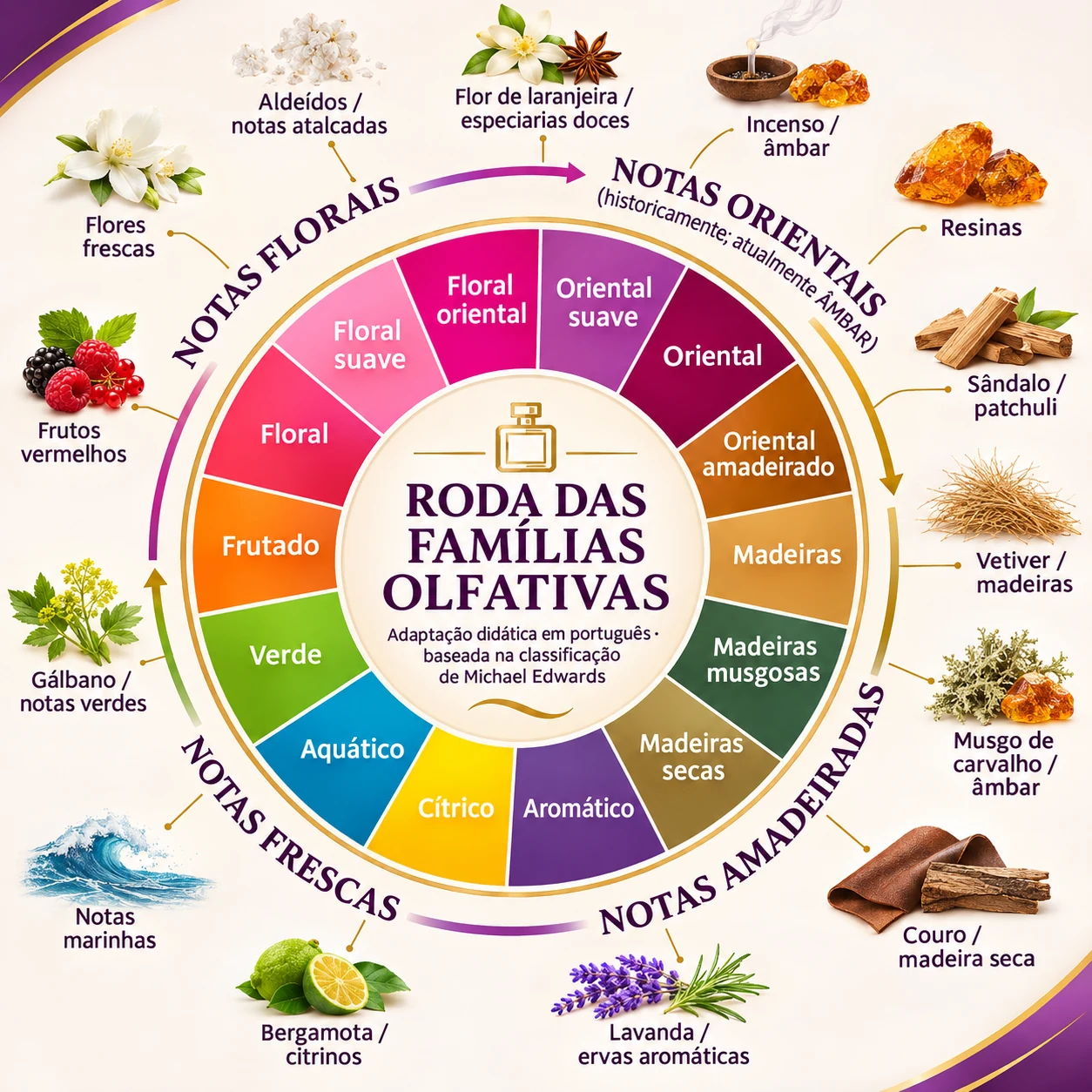
The reader-supplied illustration is based on an older version, which uses the word “Oriental”. In 2022, Edwards moved to the term Amber. In this article we use the contemporary name, while acknowledging the original term in the historical diagram. The word amber describes an olfactory family; it does not necessarily mean that natural mineral amber is present in a perfume.
How to read families, notes and accords
The wheel shows four large territories — floral, amber, woody and fresh — divided into fourteen categories in the illustrated version. Nearby sections tend to share sensory characteristics. That does not mean two fragrances in the same family will smell identical.
A family describes a broad fragrance character. A note is a recognisable impression such as bergamot, lavender or vetiver. An accord is the effect created by several materials working together. A fragrance can be classified as citrus, contain a bergamot note and still develop an aromatic heart. All three statements can be true at the same time.
Floral families: from flowers to amber warmth
The floral region begins with recognisable flowers such as rose, jasmine and orange blossom. Floral highlights those impressions directly. Soft Floral often brings aldehydic, musky or powdery textures. Floral Amber, historically called Floral Oriental, adds the warmth of spices, resins or vanilla.
These are not exclusively feminine styles. Iris, lavender, geranium and orange blossom have important roles in fragrances marketed to men. How they are framed by woods, spices and fresh notes matters more than marketing labels. The wheel helps describe those relationships without assigning scent to a particular gender.
Amber families: resins, spices and warmth
The amber region contains Soft Amber, Amber and Woody Amber. Soft Amber commonly suggests incense and sweet spices; Amber evokes resinous, vanilla-like or floral warmth; Woody Amber combines that warmth with patchouli, sandalwood, oud-style accords and other wood impressions.
Not every amber fragrance is especially sweet, strong or long-lasting. Longevity and projection depend on the complete formula, its concentration and the conditions of wear. The wheel is a guide to smell similarity, not a performance score.
Woody families: timber, moss and dry textures
The woody portion includes Woods, Mossy Woods and Dry Woods. Woods suggest cedar, sandalwood, patchouli, pine or vetiver. Mossy Woods combine woods with mossy, earthy and sometimes amber-like facets. Dry Woods bring drier, smoky, leather or tobacco impressions.
Vetiver is a good example of the limits of a single-note label. In one fragrance it can feel green and bright; in another, dry, smoky and dark. The composition as a whole is more informative than any single ingredient.
Fresh families: aromatic, citrus, water, green and fruity
The fresh territory has five directions. Aromatic often uses lavender, geranium and herbs, and includes fougère associations. Citrus suggests bergamot, lemon, grapefruit, mandarin or orange. Water evokes marine, aquatic and ozonic effects. Green brings leaves, cut grass and herbal sharpness. Fruity adds orchard fruit, berries and other juicy impressions.
Fresh does not automatically mean short-lived. A bright citrus opening can sit on a substantial woody or musky base. Likewise, an aquatic impression does not establish that the formula literally contains seawater. These labels describe perception, not ingredient lists.
Why neighbouring families are useful
If you enjoy citrus fragrances, aromatic or aquatic styles may be a sensible next step. If you like clear woody profiles, explore mossy woods. Soft floral preferences may lead toward floral amber. Moving between neighbours often reveals your preferences more accurately than randomly switching to an unrelated style.
Family alone is never enough. Check concentration, wear experience, occasion and budget. The NOTAS DE HOMEM fragrance library and fragrance finder and comparator support deeper comparisons; public reader ratings are only shown when approved real submissions exist.
Opening, heart and drydown: a separate dimension
The wheel classifies a fragrance’s overall character; it does not show a timeline. In a wear test, the opening includes the first impressions. The heart shows how the composition develops. The drydown is the profile that remains when the most volatile notes fade.
A fragrance can open with bergamot, reveal lavender in the heart and settle into amber woods. Its fragrance family and its note evolution tell different but complementary stories. The visual profiles on this blog distinguish brand-declared information from editorial interpretations and documented personal wear tests.
How to use the wheel when choosing a fragrance
Begin by identifying two or three perfumes you genuinely enjoy. Ask what makes them appealing: citrus brightness, aromatic cleanliness, green sharpness, floral texture, woodiness or amber warmth. Locate those characteristics on the wheel and first explore the neighbouring segments.
Test fragrances on skin rather than judging only their opening on a blotter. Keep the number of simultaneous tests small and compare the development later. For duration and projection, use consistent conditions: quantity applied, temperature, activity and skin characteristics can all change the result. A good fragrance is one that works in real life, not merely in its first minute.
A practical four-session scent exercise
In session one, compare citrus and aromatic styles. In session two, explore woods and dry woods. In session three, contrast a soft floral scent with soft amber. In the fourth, return to your favourites without looking at the name or price first. Try to detect patterns rather than selecting an abstract winner.
Record the probable family, the opening, the development and whether you would wear the fragrance again. Your personal impression may differ from a retailer’s classification. That does not prove anyone wrong; it simply reflects individual sensory experience and varying criteria.
What the wheel cannot tell you
The wheel cannot measure quality, value, concentration, authenticity, longevity or projection. It also cannot reveal a formula’s chemical ingredients. “Leather”, “marine”, “musk” and “amber” may describe effects constructed with many different materials. Classification systems and their versions can differ, which is why several apparently contradictory labels may coexist.
Nor is one family reserved for a particular gender, age or season. The wheel supports discovery; it is not a rulebook. Your preferences, application habits and context remain essential.
Portuguese wheel: a glossary of the fourteen families
The translated image preserves the historical names Floral oriental, Oriental suave, Oriental and Oriental amadeirado. In contemporary terminology these correspond to Floral Amber, Soft Amber, Amber and Woody Amber. Other Portuguese labels shown include Floral, Floral suave, Madeiras, Madeiras musgosas, Madeiras secas, Aromático, Cítrico, Aquático, Verde and Frutado.
The outer illustrations show useful examples: fresh flowers, aldehydes, orange blossom, incense, resins, sandalwood, vetiver, oakmoss, leather, lavender, citrus, marine impressions, galbanum and berries. These are sensory pointers rather than formulas. The older word “Oriental” appears in the image for historical context; “Amber” is the preferred contemporary term.
Continue learning with NOTAS DE HOMEM
Start with the men’s fragrance families guide, develop your vocabulary with the scent culture article, and explore the individual fragrance profiles. The new visual modules explain notes and development and clearly identify where brand information ends and editorial reading begins.
Classification is not about narrowing down what you are allowed to like. It is a way of asking better questions about fragrance and approaching new styles with a clearer sense of direction.
Sources and methodological note
The article draws on the terminology and descriptions published by Fragrances of the World and interviews with Michael Edwards. Practical examples are editorial interpretations; the illustration is an educational adaptation, not an official reproduction.