TRENDS · SUSTAINABILITY
Sustainable perfumes: what do clean, vegan and refillable fragrances mean?
A refillable bottle does not automatically make a fragrance sustainable. A vegan formula does not guarantee a smaller environmental footprint. This guide separates the claims, explains what can be checked and provides a practical price comparison.
By Luís Valente · 12 November 2026
Why sustainability matters in perfumery
A perfume involves aromatic ingredients, alcohol, water, packaging, transport and retail. Sound environmental assessment goes beyond a plant-derived ingredient or a greener-looking bottle. Glass, metals, plastic, cardboard, energy and logistics all matter.
“Sustainable perfume” is a claim to examine rather than an automatic certification. Look for documented ingredients, the packaging system, traceable evidence and realistic usage scenarios. Compare specific products, not vague marketing labels.
What does Clean Beauty actually mean?
Clean Beauty is a marketing expression defined differently by individual brands and retailers. It may refer to restricted ingredient lists or a company’s own formulation criteria, but it is not a universal guarantee of better safety or sustainability.
Cosmetics marketed in the European Union must meet safety requirements regardless of branding. Synthetic does not inherently mean unsafe, and natural does not always mean harmless. Plants can contain allergens too. Formula safety and accurate consumer information matter more than a fashionable label.
Vegan, cruelty-free and natural are different claims
Vegan generally means no animal-derived ingredients within the relevant brand or certification criteria. Cruelty-free is a claim about animal testing, not proof that a formula is vegan. Check who defines the claim and its exact scope.
Natural origin describes where a material comes from, not its overall environmental performance. Growing, processing, yield, land use, traceability and shipping can matter. Some synthetics may reduce pressure on scarce natural resources in specific cases.
The EU has specific animal-testing and marketing prohibitions covering cosmetics within its regulatory framework, while commercial cruelty-free badges may involve additional criteria. Neither label should replace proper regulatory checks.
How refillable fragrances work
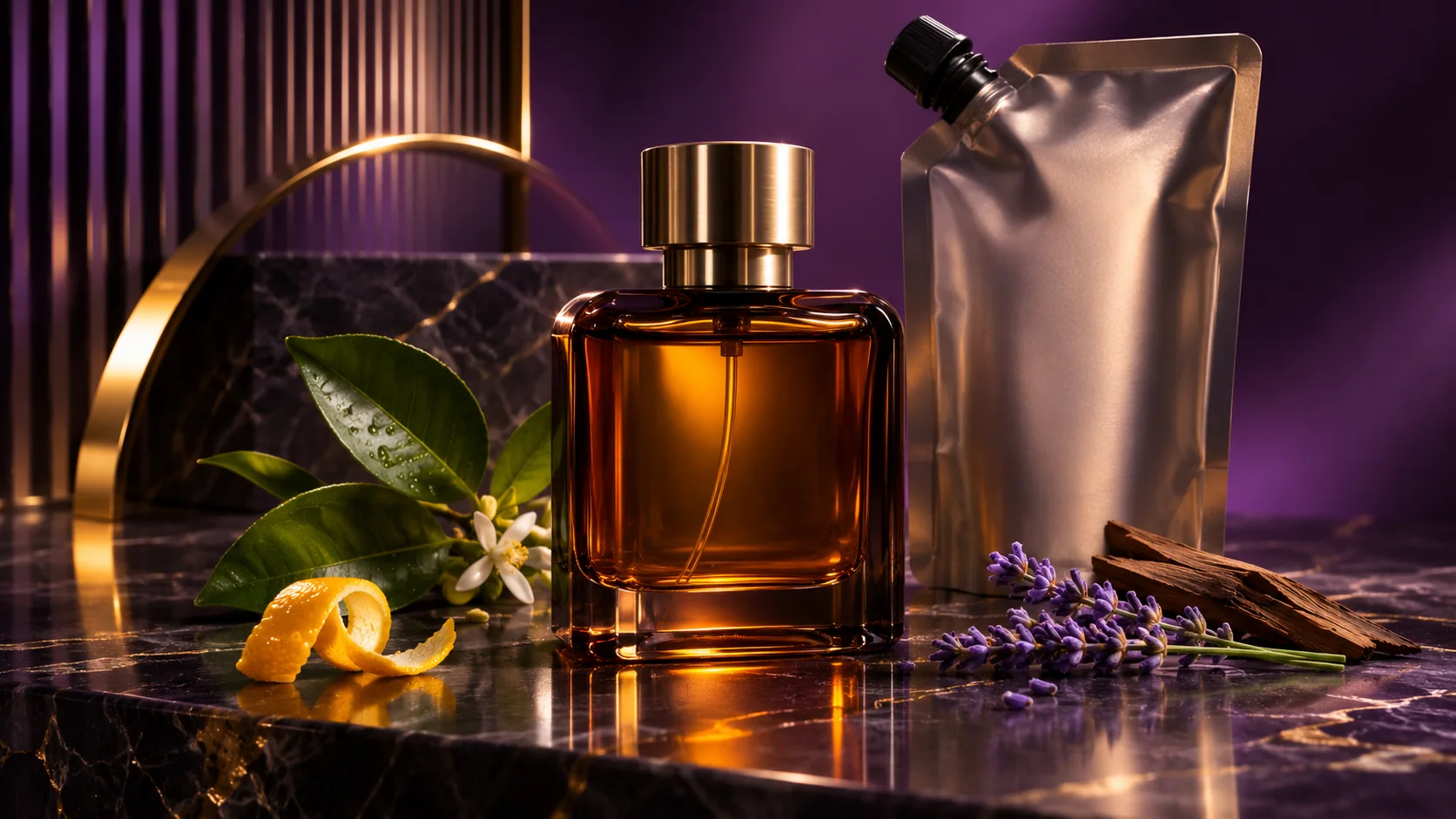
The original fragrance bottle is reused and topped up with a compatible refill, either at home or through a brand-supported service. Refill formats, fragrance concentration and bottle design vary. Always follow the brand’s instructions.
Reusing a bottle can avoid manufacturing certain components again. Reported material reductions apply to specific comparisons; saving a percentage of glass does not prove the same percentage reduction in carbon emissions or total environmental impact.
Check whether the particular version and bottle size are refillable. Avoid incompatible liquids or makeshift food containers, and protect the fragrance from contamination.
What brand examples actually show
Armani Beauty offers refill systems across selected lines including Acqua di Giò and Armani Code. L’Oréal provides packaging comparisons for defined cases, such as a 150 ml Acqua di Giò refill versus three 50 ml bottles. These are specific packaging scenarios, not proof of an entirely impact-free fragrance.
A useful claim states what was measured, which material was saved and what comparator was used. Glass, metal, plastic and cardboard figures must not be added as if they described a single metric.
Buying a refill is most relevant when the original bottle is actually reused. Someone who changes fragrance often and leaves bottles unfinished has a different consumption pattern from a regular user who repeatedly refills the same one.
How to spot greenwashing
Be wary of absolute claims such as “zero impact”, “chemical-free”, “100% eco-friendly” or “planet-safe” without verifiable evidence. All perfumes contain chemicals, including those derived from plants. Green packaging or leaves in an advert are not environmental proof.
A responsible claim identifies scope, methodology, limits and a comparison. The EU strengthened consumer protections against certain misleading environmental claims through Directive (EU) 2024/825, applicable from September 2026.
Look up certification bodies, check whether their criteria cover ingredients, packaging or supply chains, and favour measurable claims over unexplained badges.
Are fragrance refills worth the money?
Refills may cost less per millilitre, but this depends on volume, retail price, promotions and country. Compare actual purchase prices. The calculator below contrasts price per 100 ml and the hypothetical cost of obtaining the same refill volume using original bottles.
The calculation is financial only. It does not estimate carbon footprint, safety, transport, discounts or future storage conditions.
Calculator: original bottle versus refill
Enter actual prices and volumes. These are financial estimates, not environmental measurements.
Equivalent cost in original bottlesEstimated difference at refill volumePrice per 100 mlEnter four positive numbers.In this scenario, the refill is not cheaper per millilitre.A practical buying checklist
Check the exact fragrance version, concentration, original bottle compatibility, refill availability, purchase quantity and price per 100 ml. Follow filling instructions and store bottles away from excess heat and light.
Check ingredient information and remember that natural materials can still contain allergens. If fragrances trigger health symptoms, speak with a qualified professional.
Prefer published evidence with clear comparisons. Using up the perfumes already in your collection can also be a sensible decision instead of buying a replacement simply because its packaging looks greener.
Frequently asked questions
Is vegan perfume necessarily cruelty-free?
No. These are separate claims.
Does Clean Beauty mean chemical-free?
No. Natural and synthetic ingredients are chemical substances.
Do refills always reduce environmental impact?
Some packaging materials may be saved in defined scenarios; the overall impact requires broader assessment.
Can any refill go into any bottle?
No. Use only a compatible product and bottle specified by its manufacturer.
Sources and editorial criteria
- European Commission — Green claims
- European Commission — Sustainable consumption and EU 2024/825
- Armani Beauty — Refillable products
- L’Oréal — Join the Refill Movement
Editorial note: brands’ packaging percentages refer to specific comparisons and are not independent whole-life-cycle assessments.